The Value Equation, Positioning & Local Search Signals
Understanding the ICP: Personal Injury Law Firms
Why this matters: The better we understand the PI law firm ICP, the more consultative and less reactive we are as a vendor. Consultative partners set expectations, build trust, and retain clients longer. Reactive order-takers get commoditized.
PART 1: THE CLIENT'S WORLD
How PI firms position themselves to consumers, and why
How the Consumer Sees a Personal Injury Attorney
Before tactics, we have to understand the end consumer's mindset, because everything we write, design, and recommend is downstream of this.
The Core Truth
- Lawyers start at a deficit. Decades of insurance industry messaging and pop culture have convinced consumers that lawyers are bad. The "ambulance chaser" label is the leveled-up version of this, and it exists even among people in our own industry.
- We cannot fix the trust gap. No amount of marketing will make the average consumer like lawyers. That is not the goal.
- The only reason someone hires a PI attorney: money. They get hurt, pay into insurance their whole life, and the insurer offers $0 or a lowball amount. The attorney exists to get them fairly compensated.
What this means for copy and positioning
- Consider foregoing language like "we'll treat you like family" or generic client-service messaging. The consumer does not care and does not trust it.
- Lead with and accentuate outcomes: money, results, getting the fair tender the insurance company refused to pay.
The Value Equation Framework
Chris used Alex Hormozi's Value Equation as the lens for all PI consumer-facing copy, ads, and landing pages.
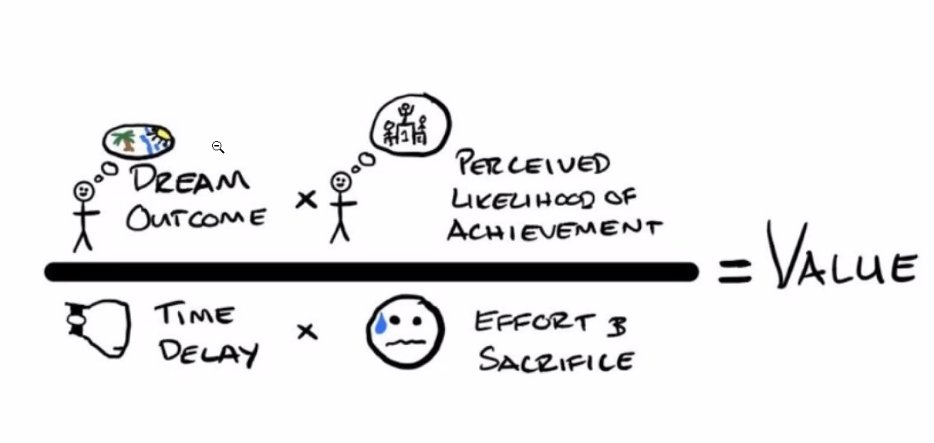
Value = (Dream Outcome x Perceived Likelihood of Achievement) / (Time Delay x Effort & Sacrifice)
Dream Outcome -- Money, Full Stop
The dream outcome for a PI consumer is not "great service" or "a caring team." It is getting compensated, ideally the full amount the insurance company refused to pay. This is the only true driver of the hire decision.
Real-world proof point Chris cited: when comparing a firm offering $60K plus great service vs. a firm offering $120K with no communication, most consumers choose the higher payout. They have already written off lawyers as people they do not want to deal with anyway.
Perceived Likelihood of Achievement -- Social Proof & Positioning
Built through awards, case results, reviews, and positioning language like "litigator," "trial attorney," and "rainmaker." This is where branding words matter. They signal "this firm can actually win for me."
Time Delay -- A Lever We Cannot Pull
We cannot promise speed. Recovery timelines are medical, not marketing-controlled. Insurers intentionally delay until the final hour. Avoid any messaging that implies fast resolution. It is outside our control and creates expectation problems downstream.
Effort & Sacrifice -- The Lever We CAN Pull (with a Catch)
Low-effort messaging like "One call, that's all," 24/7 availability, and "we come to you" reduces the anxiety of dealing with a lawyer. But anything framed as "free" decreases perceived value. No sunk cost means the consumer values it less. Reducing effort helps; stacking too much "free/easy" messaging without credibility backfires.
The bottom line for all PI copy: Because Time Delay is off the table and Effort & Sacrifice has diminishing returns, nearly all PI consumer-facing copy should be anchored on Dream Outcome (money) reinforced by Perceived Likelihood (proof/credibility). Every blog post, ad, and landing page should answer: "How does working with this firm get me more money, and why should I believe that?"
The Three Levers a PI Firm Has to Stand Out
A Short, Memorable Name
Long multi-partner names are a real handicap. Even industry insiders cannot recall them. Compare: State Farm, Geico, Progressive, Nike. All two words or fewer.
This is often an emotionally charged conversation involving ego, legacy, and the firm's own surname, so it requires trust before pushing back. The workaround is filing a DBA ("doing business as") so the firm operates under a shorter, more relevant trade name without changing the legal entity. Not available in every state, but worth raising.
Money -- Communicated Through Case Results
- Case results need a before/after comparison to land. "Offered $2,000, recovered $60,000." A number alone without context does not register.
- Do not only showcase seven or eight-figure settlements. Those are rare and unrelatable. Mix in smaller, more common results in the $20K to $40K range so the average consumer sees themselves in the outcome.
- Positioning language like "litigator" and "trial attorney" signals bigger outcomes, but most clients prefer a positive outcome without going to court. Balance this positioning carefully.
Entertainment / Memorability
Self-deprecating humor, jingles, and viral-style branding create word-of-mouth. Examples: Rafi's radio jingles, Lowrider Lawyers. The Top Dog / Sweet James / Jim Adler "Texas Hammer" pattern combines a short name, money-forward positioning, and a memorable hook. That combination is what allows smaller firms to break through.
PART 2: OUR ROLE AS THE AGENCY
How we create value, prioritize services, and have better client conversations
Partner vs. Vendor: Why Positioning is Important
A vendor fulfills the deliverable. A partner is the strategist the client looks to for direction. The difference shows up in trust and, therefore, retention: when a firm trusts us as consultative experts, they stay longer because they are relying on us for strategy, not just execution.
Takeaway for AMs: Every interaction is a chance to reinforce "partner" (consultative, proactive, guiding) vs. "vendor" (reactive, order-taking). Always come to calls with something proactive: a new angle, a fix, an introduction. Not just a status report.
From Vendor to Partner: How We Create Value
Being "a person of value" means making the client money quickly, with the least effort on their part. Think back to the value equation framework, but now think of it in terms of how we provide value to our clients. Every recommendation should map back to that.
Examples from Chris's own AM experience:
- Diagnose intake problems, even if they are outside our scope. A client with a 61% lead-to-case conversion problem is bleeding money. Surfacing that builds trust and buys 2 to 3 months of goodwill while they fix it, time we can use to improve our own results.
- Make introductions and referral relationships. If a client has overflow leads and you know another client in a nearby non-competing market, facilitate that connection—pure relationship capital.
- Help with case selection and case mix strategy. A firm referring all soft-tissue cases to a larger firm at 25% is leaving money on the table. Introducing them to a pre-litigation service like EvenUp or Finch lets them retain 80 to 90% of that value. More cases mean more reviews and more ad budget.
- Identify adjacent case types to build review volume. If a firm cannot compete head-on in auto, suggest motorcycle, slip-and-fall, or premises liability as parallel volume plays that build review velocity without direct competition.
- Review velocity coaching. Track competitors' review cadence week over week, not just totals. A competitor with fewer total reviews but 4 new reviews per week will outrank a client sitting still. Recommend team-based incentive programs, onboarding scripts, and weekly internal reporting to build urgency.
- PR agency referrals for big case results. Recommended if the firm has a budget for a good PR consultant/agency. They have journalist relationships and can get TV spots and press conferences that are local. Useful for litigation firms with a compelling case and a hook. Also feeds AI and LLM discovery surface area.
The mindset before every call:
- What is the negative the client could perceive from this report or their current experience?
- What is the proactive fix or new opportunity I can bring to offset that?
- Never repeat the same talking points call after call. Clients disengage when it feels like a hamster wheel.
Applying the Value Equation to Our Services
| Value Driver | LSA (Local Services Ads) | Google Ads | Google Maps | SEO (Organic) |
|---|---|---|---|---|
| Can I get cases? | Yes | Yes | Yes | Yes |
| Time delay (speed to results) | Almost immediate after setup | Shortly after setup and learning phase | Builds over time with reviews and relevance but incredibly valuable once performant | Slow. "Takes months" is the standard expectation |
| Effort & sacrifice | We do it for them | We do it for them | We do it for them | We do it for them |
| Virtual real estate (SERP position) | Best, especially on mobile | Second best; on mobile sometimes collapsed to one result or hidden entirely | Below LSA and Google Ads | Last |
LSA wins on the one variable SEO structurally cannot deliver: speed. That is a direct multiplier on perceived value per the Value Equation. LSA also buys us time to deliver longer-term SEO results without the client feeling stalled.
AMs should be leading more conversations with LSA and Maps performance, not keyword rankings.
SERP "Virtual Real Estate": Why Position Matters
Chris framed search results like real estate: location, location, location. Typical SERP order for a query like "Chicago car accident lawyer":
- LSA -- best virtual real estate, especially on mobile
- Google Ads -- second best; on mobile sometimes collapsed to one result or hidden entirely
- Performance Max / Demand Gen map-driven ads
- Google Maps 3-pack
- Organic results -- last
When a client's organic rankings look solid, but case volume is flat, check LSA and Maps first. That is the highest-converting real estate and often the fastest lever available.
Local Search Signals: Relevance, Distance, Prominence
Google's local ranking guidance, which Chris pulls up directly in client calls ("It's not me, here's Google"), comes down to three factors. LSA mirrors these as Region, Response, and Reviews.
Relevance
- Firm name / DBA: Names containing "accident" or "injury" rank better for those queries, the same reason a restaurant with "Thai" in its name wins "Thai food near me." Filing a DBA to align the operating name with relevant search terms is a legitimate tactic worth raising with clients.
- Review language: The words customers use in reviews feed relevance signals. Coach clients to prompt specific language during intake and follow-up.
- GBP destination URL: The page linked from the Google Business Profile is the single most important page for local ranking. Often it is not the homepage. If it is thin or lacks local and entity-specific content, the listing will not rank regardless of how strong the rest of the site is.
Distance
- Results fall off sharply beyond a roughly 5-mile radius, which is visible in Share of Local Voice reports.
- Yelp Ads cap advertising at a fixed 20-mile grid. A firm cannot advertise beyond that regardless of budget.
- Strategic implication: sometimes opening a second office in the same city does more for coverage than expanding to a new market entirely.
Prominence
- Driven by citations, backlinks, and overall brand presence. All external references to the firm.
- Review volume AND velocity both matter. A competitor with 300 reviews gaining 4 per week will outrank a client with 500 reviews gaining 1 per week. Track the cadence, not just the total.
LSA-Specific AM Checklist (Region, Response, Reviews)
- Region: Is the client's location optimized for proximity? Would a same-city second location close a coverage gap?
- Response: Audit intake speed (target: under 20 seconds). Is intake handled by a third party? Is the LSA Messages feature turned ON? This is one of the only things we can directly audit and fix, and it directly impacts LSA placement.
- Reviews: Pull competitors' weekly review cadence vs. the client's. Recommend team-based incentive programs, review request scripts at intake, and tools like Birdeye or Podium to systematize the process.
Quick-Reference Summary
| Topic | The Key Point |
|---|---|
| Our positioning | Be the partner/strategist, not the vendor/order-taker. Trust = retention. |
| The consumer | Hates lawyers, hires them only for money. Never lead with client-service messaging. |
| Value Equation | Copy = Dream Outcome (money) + Perceived Likelihood (proof). Time Delay is off-limits. Effort reduction helps but "free" erodes value. |
| Three differentiators | Short name (consider DBA) + money-forward case results (mix sizes, always before/after) + entertainment/memorability |
| Our service priority | LSA and Maps first. Fastest path to cases, best real estate, buys time for SEO to mature. |
| Local signals | Relevance (name, reviews, GBP page) + Distance (proximity, 5-mile falloff) + Prominence (citations, review velocity) |